
Introduction
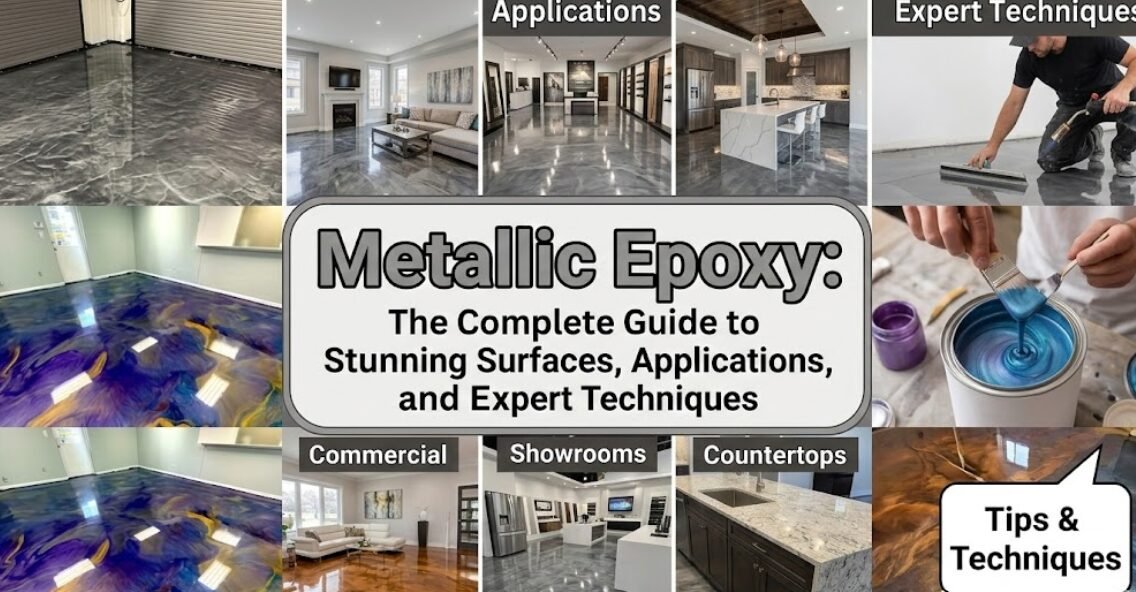
Close your eyes and picture liquid mercury flowing across a surface, catching every ray of light and transforming it into shimmering, three-dimensional depth. Now imagine freezing that moment permanently — capturing that molten beauty into a rock-hard surface you can walk on, eat at, or admire on a wall. That is essentially what metallic epoxy does, and it is revolutionizing how we think about surface design in homes, businesses, and creative spaces worldwide.
Metallic epoxy isn’t just another coating. It’s a creative medium that merges chemistry with artistry, producing surfaces so visually striking that guests, customers, and visitors can’t help but stop and stare. From dramatic floors that look like flowing lava to countertops that mimic polished gemstones, from accent walls that shimmer like abstract paintings to custom furniture pieces that become conversation starters — the possibilities are genuinely limitless.
But here’s the reality check. Metallic epoxy demands respect. It requires understanding of chemistry, surface preparation, manipulation techniques, and environmental conditions. Get it right, and you create something extraordinary. Get it wrong, and you face an expensive, frustrating mess.
This comprehensive guide walks you through everything about metallic epoxy — what it is at a molecular level, how it creates those mesmerizing effects, where it can be applied, which techniques produce which results, what it costs, and how to ensure your project succeeds. Whether you’re a homeowner exploring design options, a business owner seeking dramatic interiors, or a contractor expanding your expertise, this guide delivers the knowledge you need.
Let’s explore the science, art, and practical reality of metallic epoxy.
What Exactly Is Metallic Epoxy?
Understanding metallic epoxy starts with understanding epoxy itself — then appreciating what the metallic component adds.
Epoxy: The Foundation
Epoxy is a thermosetting polymer system consisting of two liquid components:
- Part A — Resin: The base polymer (typically bisphenol-A or bisphenol-F based)
- Part B — Hardener: A curing agent (amine or polyamide based) that triggers chemical cross-linking
When mixed in precise ratios, these components undergo an exothermic polymerization reaction — generating heat as molecular chains cross-link into a dense, three-dimensional polymer network. The result is an incredibly hard, chemically resistant, adhesive solid.
The American Chemistry Council describes epoxy resins as among the most versatile thermosetting polymers, used across industries from aerospace to construction due to their exceptional adhesion, chemical resistance, and mechanical properties (ACC, 2023).
The Metallic Element
Metallic epoxy introduces a third component:
- Metallic pigments: Ultra-fine particles — typically mica-based, aluminium-based, or synthetic metallic powders — suspended within the mixed epoxy system
These particles range from approximately 5 to 150 microns in size and possess unique optical properties:
- Light reflection: Metallic particles reflect light at varying angles based on their orientation within the cured epoxy
- Depth creation: Particles settle at different depths during curing, creating genuine three-dimensional visual effects
- Movement illusion: Because particles orient randomly, the surface appears to shift and flow as viewing angles change
Why It Looks So Extraordinary
The visual magic of metallic epoxy comes from a phenomenon called differential light interference. Here’s the simplified version:
- Light enters the clear or semi-clear epoxy surface
- Light hits metallic particles at various depths
- Particles reflect light back at different angles and intensities
- Your eyes perceive this as depth, movement, and shimmer
- As you move around the surface, reflections change — creating a “living” appearance
This is fundamentally different from metallic paint (where particles sit flat on the surface) or glitter (which produces discrete sparkle points). Metallic epoxy creates continuous, flowing visual depth that no other coating system can replicate.
Types of Metallic Epoxy Systems
Not all metallic epoxy products are created equal. Understanding the different system types helps you choose the right product for your specific application.
1. 100% Solids Metallic Epoxy
What It Is:
Contains no solvents or water — the entire liquid volume converts to solid coating during cure.
Characteristics:
- Thickest build per coat (typically 8-16 mils / 0.2-0.4mm per coat)
- Highest durability and chemical resistance
- Longest working time (30-45 minutes)
- Strongest visual depth effects
- Most demanding to apply
Best For:
Professional floor installations, commercial applications, heavy-use surfaces
Typical Cost:
AED 180-350 per litre (covers 3-5 sqm per litre depending on thickness)
2. High-Solids Metallic Epoxy (70-90% Solids)
What It Is:
Contains a small percentage of solvent or reactive diluent to improve workability.
Characteristics:
- Slightly thinner build per coat
- Easier to apply than 100% solids
- Good balance of performance and workability
- Moderate working time (25-35 minutes)
Best For:
Residential floors, countertops, advanced DIY projects
Typical Cost:
AED 120-250 per litre
3. Water-Based Metallic Epoxy
What It Is:
Epoxy resin dispersed in water carrier, producing lower VOC emissions.
Characteristics:
- Thinnest build per coat
- Lowest VOC emissions (most environmentally friendly)
- Easiest application
- Shortest working time
- Lower chemical resistance than solvent-free systems
- Less dramatic metallic effects
Best For:
Interior accent walls, decorative furniture, light-duty applications, areas with strict VOC requirements
Typical Cost:
AED 80-160 per litre
4. UV-Stable Metallic Systems (Polyaspartic-Based)
What It Is:
Uses polyaspartic resin instead of traditional epoxy — inherently UV-stable and fast-curing.
Characteristics:
- Excellent UV resistance (won’t yellow)
- Very fast cure time (2-6 hours vs. 24+ for standard epoxy)
- Superior abrasion resistance
- Challenging to apply due to short working time (10-20 minutes)
- Higher cost
Best For:
Outdoor-adjacent applications, sun-exposed interiors, fast-turnaround commercial projects
Typical Cost:
AED 250-450 per litre
Comparison Table
| System Type | Durability | UV Stability | Working Time | Ease of Use | Cost Level |
|---|---|---|---|---|---|
| 100% Solids | Excellent | Poor (needs top coat) | 30-45 min | Difficult | High |
| High-Solids | Very Good | Poor (needs top coat) | 25-35 min | Moderate | Medium-High |
| Water-Based | Good | Moderate | 20-30 min | Easy | Medium |
| Polyaspartic | Excellent | Excellent | 10-20 min | Very Difficult | Very High |
Metallic Epoxy Applications: Beyond Just Floors
While metallic epoxy flooring remains the most popular application, this remarkable material transforms virtually any rigid surface. Here’s a comprehensive look at where metallic epoxy creates impact:
1. Floors (Most Common Application)
Residential:
- Garage floors (the gateway application for many homeowners)
- Living rooms and entertainment areas
- Basements and home theatres
- Bathrooms and spa spaces
- Kitchen floors
Commercial:
- Retail showrooms and boutiques
- Restaurant and bar floors
- Hotel lobbies and corridors
- Office reception areas
- Art galleries and museums
- Automotive showrooms
Industrial:
- Manufacturing clean rooms
- Pharmaceutical facilities
- Food processing plants
- Aircraft hangars
2. Countertops and Bar Tops
Metallic epoxy countertops have exploded in popularity as an alternative to natural stone:
Advantages Over Natural Stone:
- Completely seamless (no joints, even on large surfaces)
- Virtually unlimited colour options
- Unique, one-of-a-kind appearance
- Typically 40-60% less expensive than premium marble or granite
- Lighter weight (important for island installations)
- Non-porous (doesn’t require sealing like natural stone)
Considerations:
- Requires food-safe top coat for kitchen applications
- Hot pots and pans can damage surface (always use trivets)
- Deep scratches are difficult to repair invisibly
- Requires professional installation for best results
Popular Countertop Styles:
- White and grey marble mimicry
- Dramatic black with silver veining
- Ocean blue with white waves
- Copper and gold warm tones
- Crystal-clear with subtle pearl shimmer
Cost Range:
AED 500-1,500 per linear metre (installed), compared to AED 800-3,000+ for premium natural marble
3. Walls and Feature Surfaces
Metallic epoxy accent walls create dramatic focal points impossible to achieve with paint or wallpaper:
Applications:
- Living room feature walls behind sofas or TVs
- Bedroom accent walls behind headboards
- Restaurant and bar feature walls
- Reception desk fronts and lobby walls
- Retail display backgrounds
- Bathroom accent walls
Advantages:
- Completely seamless coverage
- Three-dimensional depth impossible with flat paint
- Washable and durable
- Dramatic visual impact
- Works on drywall, concrete, wood panels, and MDF
Application Differences vs. Floors:
- Vertical application requires thixotropic (non-sag) formulations or modified techniques
- Gravity affects metallic particle movement differently on walls
- Working time is more critical (material can sag or drip)
- Typically applied in thinner coats
- May require specialized primers for different wall substrates
4. Furniture and Custom Pieces
The maker community has embraced metallic epoxy for stunning custom furniture:
Popular Projects:
- River tables: Wood slabs with metallic epoxy “rivers” flowing through natural voids
- Coffee tables: Entire surfaces coated in metallic epoxy
- Dining tables: Large-scale metallic epoxy surfaces over wood or MDF bases
- Side tables and nightstands: Smaller accent pieces with dramatic tops
- Shelving: Metallic epoxy-coated display shelves
- Desk surfaces: Custom office desks with unique metallic finishes
Key Considerations:
- Furniture applications require food-safe, scratch-resistant top coats
- Heat resistance is limited (always use coasters and trivets)
- UV exposure through windows can yellow unprotected surfaces
- Weight considerations for large pieces
5. Artwork and Decorative Panels
Artists and designers create stunning pieces using metallic epoxy on:
- Canvas panels
- Wood rounds and slabs
- Metal sheets
- Acrylic panels
- Custom-shaped substrates
These pieces range from small wall hangings to massive installation art in commercial spaces.
6. Outdoor Applications (Limited)
Where Metallic Epoxy Can Work Outdoors:
- Covered patios and verandas (protected from direct sun and rain)
- Covered pool decks (with aggressive anti-slip treatment)
- Garage floors opening to exterior (with UV-stable top coat)
Where It Should NOT Be Used Outdoors:
- Fully exposed surfaces (direct UV, rain, temperature extremes)
- Uncovered pool surrounds
- Driveways and walkways (temperature cycling causes failure)
- Any surface subject to freeze-thaw cycles
For outdoor applications, polyaspartic or polyurea systems offer superior performance.
Metallic Epoxy Colour Palette and Design Techniques
The Colour Spectrum
Metallic epoxy pigments are available in virtually any colour imaginable. Here are the most popular categories:
Neutrals and Metallics:
| Colour | Visual Effect | Popular Applications |
|---|---|---|
| Silver/Platinum | Cool, contemporary, polished | Modern homes, offices, showrooms |
| Charcoal/Gunmetal | Dramatic, industrial, sophisticated | Garages, bars, man caves |
| Pearl White | Clean, luminous, spacious | Spas, bathrooms, luxury kitchens |
| Champagne | Warm, subtle, elegant | Hotel lobbies, dining rooms, bedrooms |
Warm Tones:
| Colour | Visual Effect | Popular Applications |
|---|---|---|
| Gold | Opulent, glamorous, rich | Luxury retail, hospitality, fine dining |
| Copper | Earthy, industrial-warm | Breweries, rustic restaurants, lofts |
| Bronze | Classic, warm, traditional | Executive offices, libraries, lounges |
| Rose Gold | Trendy, feminine, modern | Salons, boutiques, bedrooms |
Cool Tones:
| Colour | Visual Effect | Popular Applications |
|---|---|---|
| Ocean Blue | Aquatic, serene, dramatic | Pool areas, coastal homes, themed spaces |
| Teal | Deep, mysterious, luxurious | Restaurants, hotels, feature walls |
| Emerald Green | Natural, bold, sophisticated | High-end retail, art galleries |
| Purple/Amethyst | Royal, creative, unique | Entertainment venues, creative spaces |
Bold and Dramatic:
| Colour | Visual Effect | Popular Applications |
|---|---|---|
| Black/Midnight | Ultra-dramatic, bold | Nightclubs, theatres, luxury garages |
| Red/Crimson | Energetic, passionate | Restaurants, automotive, entertainment |
| Turquoise | Vibrant, tropical, playful | Children’s spaces, themed venues |
Advanced Design Techniques
The installer’s manipulation technique determines the final pattern. Here are the primary methods:
Technique 1: Roller Manipulation
How It Works: Using a standard paint roller, the installer creates directional patterns by rolling in specific directions through the wet metallic epoxy.
Visual Effect: Flowing, directional waves with subtle metallic shimmer
Difficulty Level: Beginner-Moderate
Best For: Subtle, elegant floors; large commercial areas requiring consistent pattern
Technique 2: Squeegee Swirling
How It Works: A flat squeegee is used in sweeping, circular, or figure-eight motions to create flowing patterns.
Visual Effect: Classic “liquid marble” appearance with dramatic swirls
Difficulty Level: Moderate
Best For: Residential floors, countertops, feature surfaces
Technique 3: Solvent Release (Acetone or Denatured Alcohol)
How It Works: Fine mist of solvent is sprayed over wet metallic epoxy from 30-60cm height. The solvent disrupts surface tension, causing metallic particles to separate into organic cellular patterns.
Visual Effect: Dramatic crackled, cellular, or “lava flow” patterns with exceptional depth
Difficulty Level: Moderate-Advanced
Best For: Statement floors, feature walls, artistic installations
Safety Note: Proper ventilation and fire safety precautions are essential — solvents are flammable and must be used in well-ventilated spaces away from ignition sources. The National Fire Protection Association (NFPA) classifies these solvents as flammable liquids requiring appropriate storage and handling protocols (NFPA 30, 2021).
Technique 4: Heat Application
How It Works: A propane torch or heat gun is carefully passed over the wet surface, creating convection currents that move metallic particles.
Visual Effect: Organic, flowing patterns with natural movement; cell-like separations
Difficulty Level: Advanced (risk of scorching or igniting material if mishandled)
Best For: Artistic installations, custom furniture, feature surfaces
Technique 5: Multi-Colour Layering
How It Works: Two or more colours of metallic epoxy are applied in sequence while the first colour is still wet, then manipulated together.
Visual Effect: Complex, multi-dimensional colour transitions; galaxy/nebula effects; ocean scenes
Difficulty Level: Very Advanced
Best For: High-end custom installations, art pieces, premium commercial spaces
Technique 6: Gravity Flow (Self-Levelling)
How It Works: Metallic epoxy is simply poured and allowed to self-level with minimal manipulation.
Visual Effect: Subtle, elegant shimmer with natural, unpredictable metallic flow
Difficulty Level: Beginner (easiest technique)
Best For: Understated elegance, large areas requiring consistency, first-time projects
The Science Behind Durability: Why Metallic Epoxy Performs
Understanding metallic epoxy’s performance characteristics helps you specify the right system for your application.
Mechanical Properties
Once fully cured (typically 7 days for full chemical cure), quality metallic epoxy exhibits:
- Compressive strength: 10,000-12,000 PSI (significantly stronger than concrete alone at 3,000-5,000 PSI)
- Tensile strength: 4,000-6,000 PSI
- Flexural strength: 6,000-8,000 PSI
- Adhesion to concrete: 300-400 PSI (exceeds the tensile strength of concrete itself — meaning the concrete will fail before the epoxy bond)
According to the American Society for Testing and Materials (ASTM), these values place quality epoxy coatings among the highest-performing floor finish systems available (ASTM D4541, ASTM C579).
Chemical Resistance
Quality metallic epoxy systems resist:
- Household cleaners and detergents
- Automotive fluids (oil, gasoline, brake fluid, coolant)
- Mild acids (vinegar, citric acid, dilute hydrochloric acid)
- Mild alkalis (ammonia, dilute sodium hydroxide)
- Alcohols and solvents (brief exposure)
- Food and beverage stains (coffee, wine, cooking oils)
- Salt and deicing chemicals
Limited resistance to:
- Concentrated acids (hydrofluoric, concentrated sulfuric)
- Concentrated solvents (prolonged acetone or MEK exposure)
- Some aggressive industrial chemicals
Thermal Properties
- Heat resistance: Most systems tolerate continuous temperatures up to 60°C (140°F) and brief exposure up to 120°C (250°F)
- Cold resistance: Remains stable to approximately -20°C (-4°F)
- Thermal shock sensitivity: Rapid temperature changes can cause micro-cracking (avoid placing extremely hot items directly on surface)
UV Stability (Critical Consideration)
Standard epoxy resins are NOT UV-stable. When exposed to ultraviolet light, they undergo a process called photodegradation — molecular bonds break down, causing:
- Yellowing and ambering of clear coat
- Chalking of surface
- Loss of gloss
- Eventual coating deterioration
Solution: Always apply a UV-stable top coat:
| Top Coat Type | UV Stability | Cure Time | Cost | Best For |
|---|---|---|---|---|
| Aliphatic Polyurethane | Excellent | 24-48 hours | Moderate-High | Most applications |
| Polyaspartic | Excellent | 2-6 hours | High | Fast-turnaround projects |
| Aromatic Polyurethane | Poor | 24-48 hours | Moderate | Interior-only, no direct sun |
| Acrylic Sealer | Good | 4-8 hours | Low | Light-duty, temporary |
Installation Requirements and Preparation
Proper preparation determines approximately 80% of a metallic epoxy project’s success. Here’s what’s required:
Substrate Requirements
Concrete (Most Common):
- Minimum 28 days cure age (60+ days preferred in hot climates)
- Minimum 3,000 PSI compressive strength
- Moisture content below 75% relative humidity (ASTM F2170) or 3 lbs/1,000 sq ft/24 hours (ASTM F1869)
- No previous sealers, paints, or coatings (or completely removed)
- Clean, sound, and free of contamination
Wood (For Countertops and Furniture):
- Must be sealed, stable, and moisture-free
- Use epoxy-specific primer designed for wood
- Ensure complete adhesion between wood and primer
- Sand to appropriate profile (80-120 grit)
MDF/Plywood (For Walls and Panels):
- Seal all edges to prevent moisture absorption
- Apply appropriate primer system
- Ensure structural rigidity (metallic epoxy is rigid — flexible substrates cause cracking)
Surface Preparation Methods
| Method | Equipment | Surface Profile Created | Best For |
|---|---|---|---|
| Diamond Grinding | Floor grinder with diamond segments | CSP 2-3 (smooth) | Residential floors, clean concrete |
| Shot Blasting | Steel shot blast machine | CSP 3-5 (moderate) | Commercial floors, contaminated surfaces |
| Scarifying | Rotary scarifier | CSP 5-7 (aggressive) | Heavy coatings removal, severely contaminated |
| Sanding | Orbital sander, belt sander | Fine profile | Countertops, furniture, walls |
CSP = Concrete Surface Profile (ICRI scale 1-10)
The International Concrete Repair Institute (ICRI) publishes detailed guidelines for concrete surface preparation (ICRI Technical Guideline 310.2R), which serve as the industry standard for ensuring adequate coating adhesion (ICRI, 2022).
Environmental Conditions During Application
| Factor | Acceptable Range | Why It Matters |
|---|---|---|
| Air Temperature | 15-30°C (59-86°F) | Below 15°C: slow/incomplete cure. Above 30°C: too-rapid cure, reduced working time |
| Surface Temperature | 15-30°C (min 3°C above dew point) | Cold surfaces cause condensation and adhesion failure |
| Relative Humidity | Below 85% | High humidity causes “blushing” (whitening/clouding) |
| Air Movement | Minimal during application; ventilation after | Drafts create dust contamination and uneven curing |
Dubai-Specific Note: UAE’s extreme heat requires careful scheduling. Professional installers in Dubai typically:
- Work in fully air-conditioned spaces
- Use slow-cure hardener systems during summer
- Schedule work during early morning hours when possible
- Monitor concrete temperature before application
- Allow extended acclimation periods for materials
Cost Analysis: Complete Budget Guide
Material Costs by Application
| Application | Material Cost (AED/sqm) | Material Cost (USD/sqm) |
|---|---|---|
| Floor — Basic (single colour, simple pattern) | 80-150 | 22-41 |
| Floor — Premium (multi-colour, complex pattern) | 150-300 | 41-82 |
| Countertop — Basic | 200-400 | 55-109 |
| Countertop — Premium | 400-700 | 109-191 |
| Wall — Basic | 100-200 | 27-55 |
| Wall — Premium | 200-400 | 55-109 |
| Furniture — Basic | 150-300 per piece | 41-82 per piece |
| Furniture — Premium | 300-800 per piece | 82-218 per piece |
Labour Costs by Application
| Application | Labour Cost (AED/sqm) | Labour Cost (USD/sqm) |
|---|---|---|
| Floor — Residential | 100-250 | 27-68 |
| Floor — Commercial | 150-400 | 41-109 |
| Countertop | 300-600/linear metre | 82-163/linear metre |
| Wall | 120-300 | 33-82 |
| Furniture | Project-based (typically AED 500-3,000 per piece) | — |
Complete Project Cost Examples
Project 1: Residential Garage Floor (60 sqm)
| Item | Cost (AED) |
|---|---|
| Concrete preparation | 2,400 |
| Primer system | 1,800 |
| Metallic epoxy materials | 6,000 |
| UV-stable top coat (2 coats) | 3,600 |
| Labour | 9,000 |
| Anti-slip treatment | 900 |
| Total | 23,700 |
Project 2: Kitchen Countertop (8 linear metres)
| Item | Cost (AED) |
|---|---|
| Surface preparation | 800 |
| Primer and base coat | 640 |
| Metallic epoxy materials | 2,400 |
| Food-safe top coat | 1,200 |
| Labour | 3,200 |
| Total | 8,240 |
Project 3: Commercial Showroom Floor (250 sqm)
| Item | Cost (AED) |
|---|---|
| Concrete preparation | 10,000 |
| Primer system | 7,500 |
| Metallic epoxy (premium multi-colour) | 50,000 |
| UV-stable top coat (3 coats) | 18,750 |
| Anti-slip treatment | 3,750 |
| Labour | 62,500 |
| Total | 152,500 |
Project 4: Feature Wall (15 sqm)
| Item | Cost (AED) |
|---|---|
| Wall preparation and priming | 1,500 |
| Metallic epoxy materials | 3,000 |
| Clear top coat | 1,500 |
| Labour | 3,750 |
| Total | 9,750 |
DIY vs. Professional Installation: Making the Right Choice
When DIY Might Work
- Small furniture pieces (coffee tables, side tables)
- Decorative art panels
- Practice pieces before larger projects
- Simple single-colour applications with minimal pattern demands
- You have experience with resin work or coatings
When You Must Hire a Professional
- Any floor installation (substrate preparation requires professional equipment)
- Countertops in kitchens or bathrooms (food safety and waterproofing requirements)
- Commercial spaces (warranty, liability, and building code considerations)
- Multi-colour or complex pattern installations
- Large-scale projects (100+ sqm)
- Spaces requiring anti-slip treatment
- Areas with UV exposure (proper top coat system essential)
DIY Pitfalls to Avoid
Inadequate Surface Preparation:
The number one cause of DIY metallic epoxy failure. Skipping proper grinding, etching improperly, or failing to test moisture leads to delamination and peeling.
Incorrect Mix Ratios:
Epoxy requires precise ratio mixing. Even small deviations cause soft spots, incomplete cure, or surface defects.
Working Too Slowly:
Metallic epoxy has limited working time. Once the pot life expires, the material becomes unworkable — and you can’t “pause” an epoxy application.
Ignoring Temperature and Humidity:
Applying metallic epoxy outside recommended environmental conditions produces clouding, poor adhesion, and compromised durability.
Skipping the Top Coat:
Without a UV-stable top coat, your beautiful metallic surface will yellow within months if exposed to any natural light.
Maintenance and Long-Term Care
Daily Maintenance
- Sweep or dust mop to remove abrasive particles
- Wipe up spills immediately using soft cloth
- For general cleaning, use pH-neutral floor cleaner and warm water
Weekly Maintenance
- Damp mop entire surface with appropriate cleaner
- Inspect high-traffic areas for wear or scuffing
- Clean entry mats that protect floor from incoming grit
Monthly Maintenance
- Deep clean with manufacturer-recommended products
- Inspect edges, transitions, and joints for any lifting or damage
- Address minor scratches with touch-up top coat
Annual Maintenance
- Professional assessment of coating condition
- Maintenance top coat application if wear is evident
- Re-apply anti-slip treatment if traction has diminished
Metallic Epoxy in Dubai and the UAE
For UAE-based projects, specific regional considerations apply:
Climate Advantages
- Indoor applications perform excellently in Dubai’s air-conditioned environments
- Seamless surface prevents sand and dust accumulation in joints
- Chemical resistance handles aggressive cleaning products used in Gulf households
- Moisture resistance manages humidity fluctuations common in coastal UAE cities
Climate Challenges
- Extreme outdoor heat limits exterior applications
- High humidity requires careful installation scheduling and environmental control
- Intense UV exposure makes UV-stable top coats absolutely essential
- New construction concrete requires extended curing before coating (minimum 28 days, ideally 60+ in hot conditions)
Local Market Considerations
Dubai’s growing metallic epoxy market includes both experienced specialists and newcomers. Quality varies significantly. At Modenex Decor Dubai, we help clients navigate this landscape by connecting them with vetted specialists who understand UAE-specific challenges and deliver consistently excellent results.
Popular Dubai Applications
- Villa garages (especially for car collector showcase spaces)
- Penthouse living spaces (dramatic floor statements)
- Restaurant and lounge floors (unique ambiance creation)
- Retail showrooms (luxury brand environments)
- Hotel lobbies (memorable first impressions)
- Home spa bathrooms (seamless, waterproof luxury)
Common Mistakes and How to Avoid Them
Mistake 1: Choosing Price Over Quality
Problem: Budget metallic epoxy products often use inferior pigments, lower-quality resins, and inadequate hardeners — producing disappointing results that fail prematurely.
Solution: Invest in reputable brands with proven track records. The cost difference between budget and premium products is typically 20-40%, but performance and longevity differences are dramatic.
Mistake 2: Rushing Surface Preparation
Problem: Inadequate preparation causes delamination — the coating literally peels away from the substrate, usually within 6-18 months.
Solution: Allocate at least 30% of total project time to preparation. Mechanical profiling is non-negotiable.
Mistake 3: Unrealistic Pattern Expectations
Problem: Expecting the exact pattern from an Instagram photo. Metallic epoxy is inherently organic and unpredictable.
Solution: Discuss general style, colour, and movement direction with your installer. Accept (and embrace) that the organic nature of metallic epoxy means your floor will be unique — not identical to a reference photo.
Mistake 4: Forgetting Anti-Slip Treatment
Problem: High-gloss metallic surfaces become dangerously slippery when wet.
Solution: Always include anti-slip aggregate in the final top coat for any floor application. Fine-grade aggregate maintains visual beauty while dramatically improving safety.
The Occupational Safety and Health Administration (OSHA) requires adequate slip resistance in commercial environments and recommends minimum coefficient of friction standards for walking surfaces (OSHA, 2023).
Mistake 5: Neglecting UV Protection
Problem: Yellowing and degradation from UV exposure within months.
Solution: UV-stable top coat is mandatory for any surface exposed to natural light. No exceptions.
Frequently Asked Questions About Metallic Epoxy
How long does metallic epoxy last?
With proper installation and maintenance: 15-25 years for residential applications and 10-20 years for commercial use. The metallic base layer lasts indefinitely if protected by maintenance top coats applied every 5-10 years.
Is metallic epoxy food-safe for kitchen countertops?
Once fully cured (minimum 7 days), quality metallic epoxy with a food-safe top coat (FDA-compliant formulation) is safe for kitchen countertop use. The cured material is chemically inert and non-toxic. Always verify food-safety certification with the specific product manufacturer.
Can metallic epoxy be applied over existing tile floors?
Technically possible but not ideal. Tiles must be firmly bonded, grout lines filled level, surfaces mechanically abraded, and a bonding primer applied. Results are generally less predictable than application over properly prepared concrete.
Does metallic epoxy crack?
Metallic epoxy itself rarely cracks. However, if the concrete substrate beneath it cracks (due to settling, structural movement, or inadequate joints), the crack will telegraph through the epoxy. Proper substrate inspection and crack repair before installation prevents this issue.
Can metallic epoxy be repaired?
Minor repairs (small scratches, chips) can be addressed with spot application of matching epoxy and top coat. However, major repairs rarely match the original pattern perfectly due to the organic nature of metallic flow. Prevention through proper surface protection is always preferable to repair.
Is metallic epoxy environmentally friendly?
Once cured, metallic epoxy is chemically stable and does not emit VOCs. During application, however, some systems release solvents that require proper ventilation. Water-based metallic epoxy systems offer the lowest environmental impact. Look for products with GREENGUARD Gold or FloorScore certifications for verified low-emission performance.
How slippery is metallic epoxy?
Standard high-gloss metallic epoxy is very slippery when wet. Adding anti-slip aggregate to the top coat resolves this issue while maintaining visual appeal. This treatment is essential for floors in wet areas, commercial spaces, and any application where safety is a concern.
Conclusion
Metallic epoxy represents a genuinely unique category in the world of surface design — a material that combines industrial-grade toughness with artistic beauty in ways no other coating system can match. From floors that flow like liquid silver to countertops that shimmer like polished gemstones, from accent walls that captivate visitors to custom furniture pieces that become family heirlooms — metallic epoxy transforms ordinary surfaces into extraordinary works of functional art.
The key to successful metallic epoxy projects lies in understanding the material’s capabilities and limitations, choosing the right system for your specific application, preparing substrates meticulously, and working with skilled professionals who bring both technical expertise and artistic sensibility to every project.
Whether you’re considering a dramatic metallic epoxy flooring transformation for your home, a show-stopping countertop for your kitchen, or a breathtaking feature wall for your business, this guide has equipped you with the knowledge to make confident, informed decisions.
At Modenex Decor Dubai, we specialize in premium surface design solutions — including metallic epoxy systems — tailored to the UAE’s unique climate and design expectations. Our team connects you with verified specialists, premium materials, and expert guidance to ensure your metallic epoxy project delivers results that exceed your expectations.
Visit Modenex Decor Dubai today to explore metallic epoxy possibilities and discover how this remarkable material can transform your surfaces into something truly extraordinary.